



Interested in our services
Contact our experts to provide further information




The rapid development of single-cell omics technologies has provided powerful new perspectives for understanding cellular heterogeneity. Among them, single-cell proteomics enables direct measurement of dynamic protein changes within individual cells. This is essential for uncovering cellular functions and precisely characterizing cell states.
However, single-cell proteomics still faces major technical challenges in single-cell isolation, sample preparation, identification depth, and detection throughput.
To better meet the growing demand for single-cell proteomics research, PTM BIO launched China’s first true single-cell proteomics solution in August 2021. After years of technical refinement and innovation, PTM BIO has now upgraded the platform to Single-Cell Proteomics 2.0, featuring breakthroughs across four core technology systems to further decode the molecular information of individual cells.
PTM BIO uses CellenONE, an industry-leading fully integrated and automated front-end sample preparation platform, to enable seamless automation from cell suspension to single-cell sample preparation.
Combined with advanced visual processing technology, the platform performs gentle and precise cell sorting. Through recoverable droplet deposition, it ensures that each individual cell successfully enters the downstream workflow, enabling true single-cell isolation.
Cells sorted by CellenONE show higher viability, lower sample loss, and greatly improved sorting efficiency, providing a reliable foundation for downstream single-cell proteomics analysis.
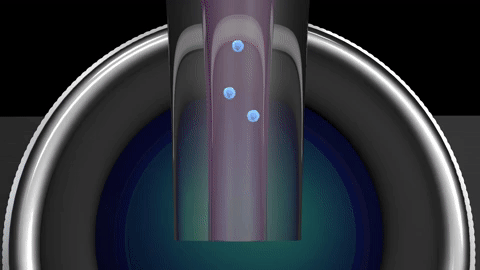
Figure. Workflow of PTM BIO’s Single-Cell Proteomics 2.0 Sample Preparation Platform
PTM BIO has developed a proprietary single-cell proteomics sample preparation system, integrating optimized reagents, dedicated devices, and a simplified one-step extraction workflow.
Compared with conventional multi-step protocols, this workflow improves protein extraction efficiency, reduces sample loss, and enables stable processing of individual cells in each sample well through nanoliter-scale reagent dispensing.
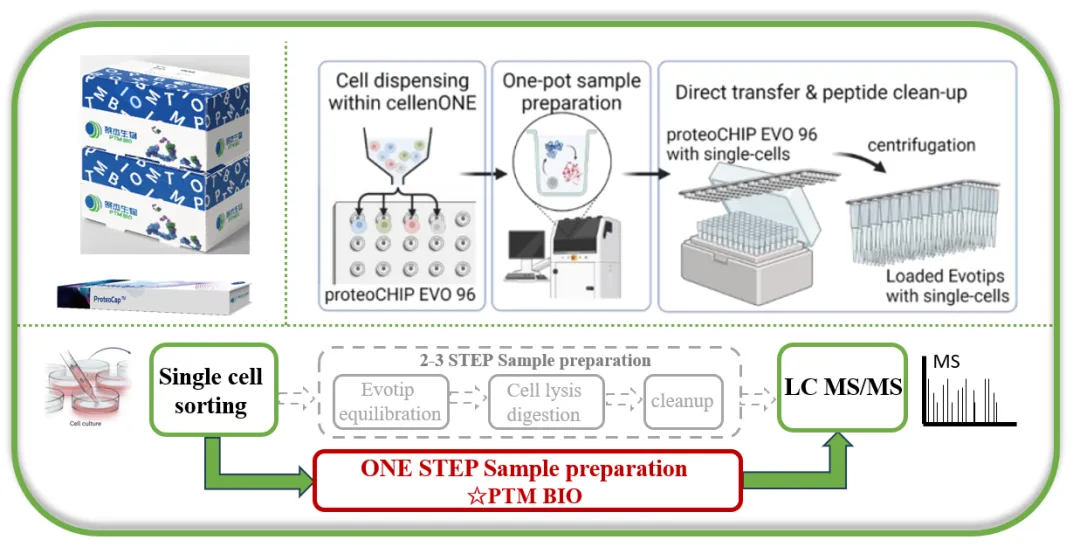
Figure. PTM BIO’s Proprietary Single-Cell Sample Preparation System and Supporting Reagents
As a leading company in proteomics-driven precision medicine, PTM BIO has pioneered and launched the next-generation depth Proteomics technology, enabling deep coverage for conventional proteomics.
PTM BIO has further extended Proteomics to single-cell proteomics, continuously upgrading single-cell analysis across multiple dimensions, including detection throughput, sensitivity, and quantitative accuracy. This substantially improves the analytical performance of single-cell proteomics, achieving an unprecedented level of proteome coverage and enabling deeper insights into cellular biological functions.
Protein data from individual cells differ substantially from bulk tissue proteomics data. To address this, PTM BIO has developed a dedicated single-cell proteomics bioinformatics workflow.
This workflow provides high-quality information for cellular heterogeneity studies and single-cell-level proteome profiling, supporting end-to-end analysis and visualization, including unsupervised clustering, cell type annotation, functional annotation, cell cycle analysis. It empowers researchers to investigate biological mechanisms at true single-cell resolution.
PTM BIO performed single-cell proteomics analysis across three cell lines: 293T, HeLa, and A549, covering a total of 150 single cells.
The average protein identification depth across all single cells reached 2,728 proteins, with a total depth exceeding 3,600 proteins. Compared with the previous-generation single-cell proteomics product, detection depth has increased by more than 100%, redefining the current depth benchmark for single-cell proteomics.
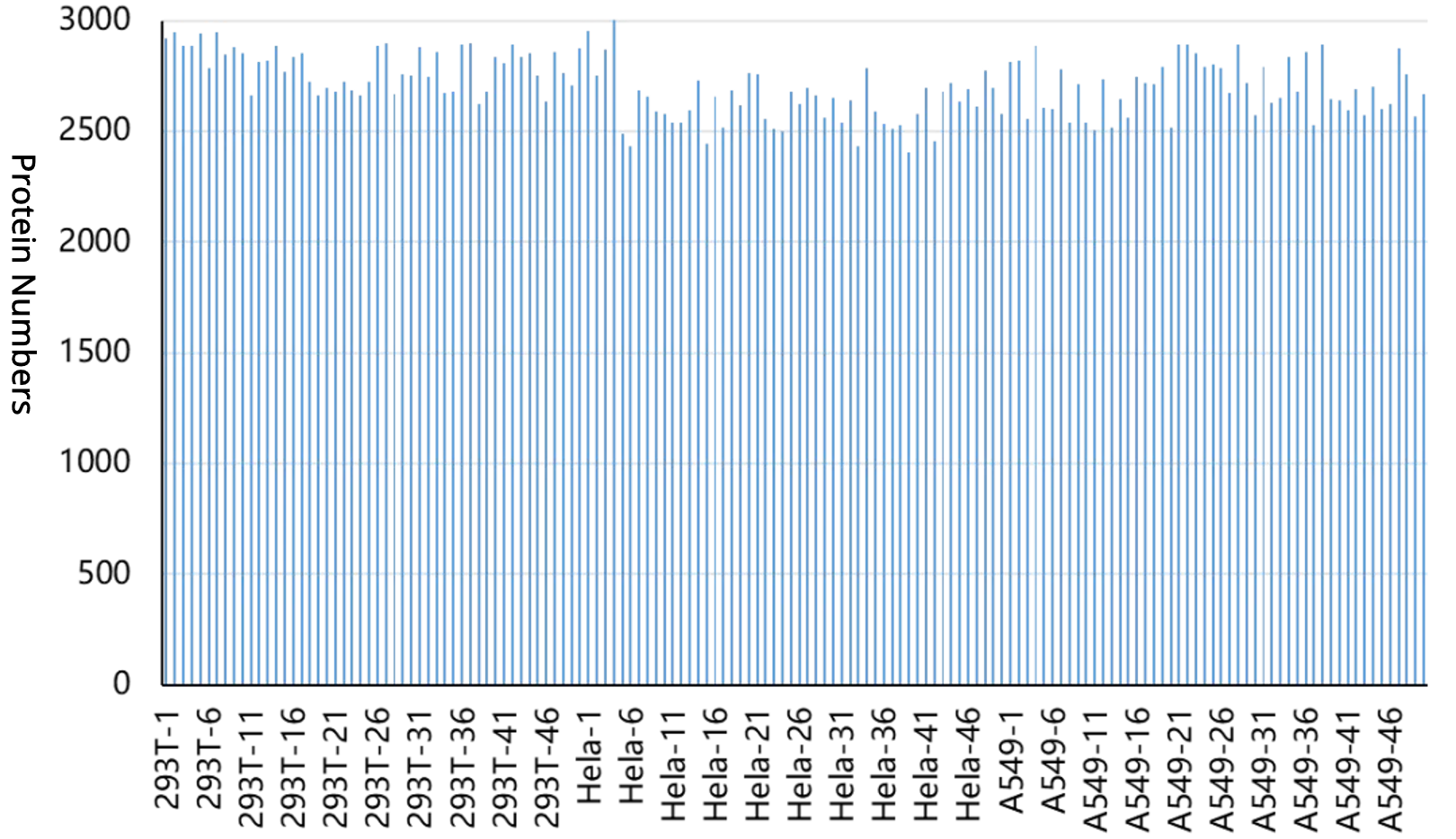 Figure. Protein Identification Depth in Individual Cells — PTM BIO Internal Data
Through data analysis, the three cell types can be clearly distinguished. The overall dataset demonstrates high stability and strong consistency, reflecting the superior data quality of PTM BIO’s Single-Cell Proteomics 2.0 solution.
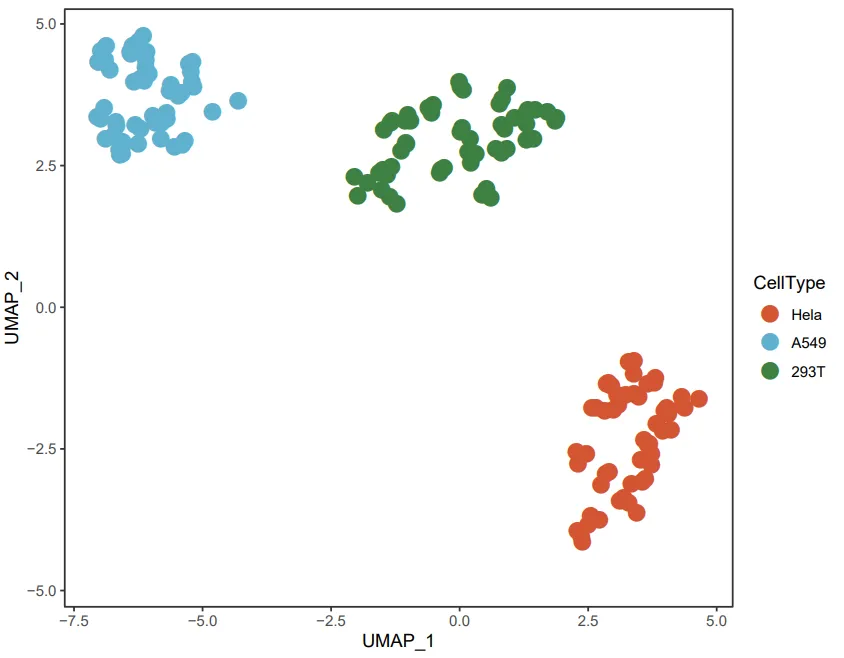
Figure. UMAP Visualization of Different Cell Populations — PTM BIO Internal Data
Based on PTM BIO’s proprietary single-cell sample preparation system, combined with an industry-leading cell sorting platform, high-resolution mass spectrometry, and PTM BIO’s dedicated single-cell bioinformatics platform, we provide an end-to-end single-cell proteomics workflow:
Cell suspension → Single-cell sorting → Single-cell sample preparation → Accurate single-cell protein identification → Single-cell proteomics bioinformatics analysis
This integrated solution supports the construction of more refined and comprehensive cellular functional atlases and enables deeper investigation of biological mechanisms at single-cell resolution.
Single-cell proteomics provides high-resolution protein-level information for biological systems, enabling precise insights into cellular heterogeneity, high-resolution protein molecular atlas construction, and spatial proteome network analysis.
It has broad application value in key research areas such as tumor heterogeneity, cell differentiation, cell cycle regulation, reproductive development, neurodevelopment, and immune regulation.
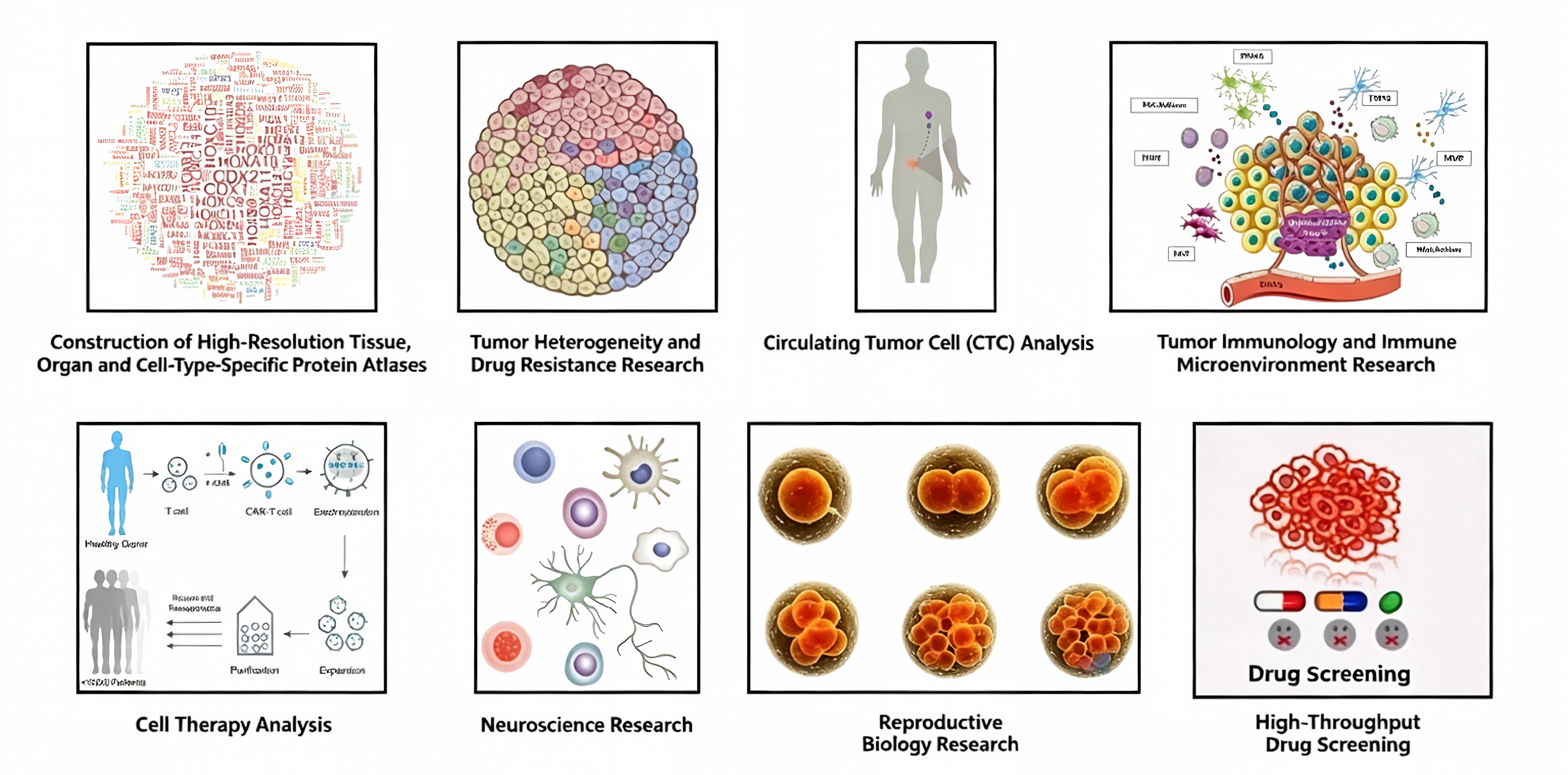 Figure. Eight Major Application Scenarios of PTM BIO Single-Cell Proteomics
1.Stelloo S, et al. 2024. Deciphering lineage specification during early embryogenesis in mouse gastruloids using multilayered proteomics. Cell Stem Cell.
2.Huang J, et al. 2023. Multi-Omics Analysis Reveals Translational Landscapes and Regulations in Mouse and Human Oocyte Aging. Adv Sci.
Interested in our services
Contact our experts to provide further information