



On 21 May 2026, the ‘Global Summit on Innovative Proteomics Technologies and Intelligent Spatial Multi-Omics Analysis’, jointly organised by PTM Bio, Inc., the University of Malaya and Biomed Global, concluded successfully at the Faculty of Medicine, University of Malaya. As a global leader in proteomics and a pioneer in protein modification omics, PTM Bio has joined forces with leading academic institutions and industry partners across the Asia-Pacific region to promote academic exchange and innovative applications of proteomics technology within the region.
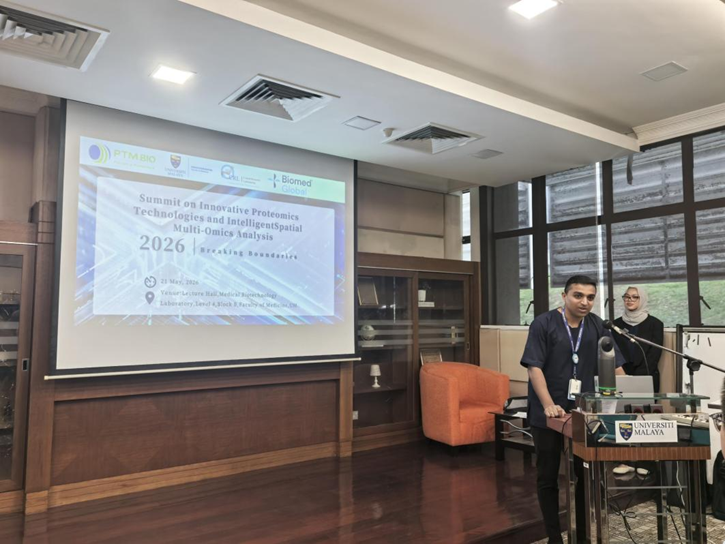
At the opening ceremony of the forum, Dr. Krishnamurithy Genasan, Senior Lecturer from the Department of Physiology, Faculty of Medicine, University of Malaya, delivered the opening remarks on behalf of the co-organizers. He extended a warm welcome to the delegation from PTM Bio on their visit to the University of Malaya and expressed his honour at the joint organisation of this academic forum by the three parties. Dr Krishnamurithy noted that such high-level academic exchanges have successfully built a bridge of communication between the University of Malaya and PTM Bio, helping to strengthen cooperation and exchanges between China and Malaysia in the field of life sciences, and laying a solid foundation for the establishment of long-term and stable relations of exchange and cooperation between the two parties.
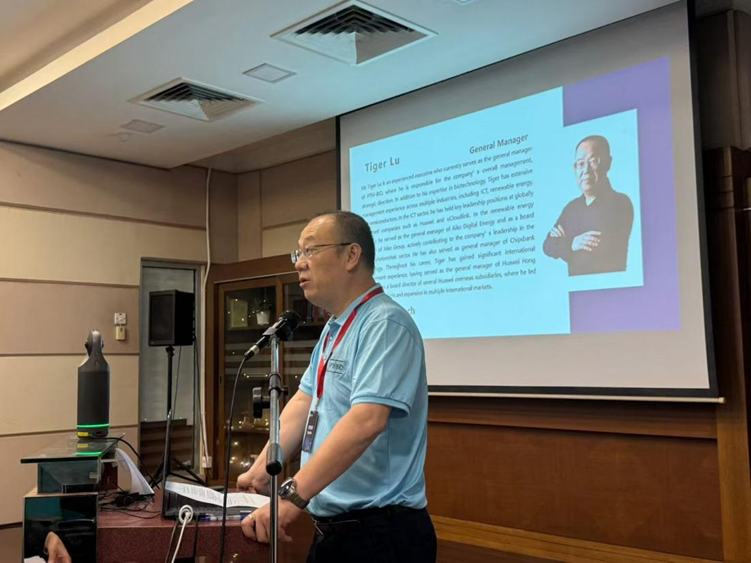
Mr. Tiger Lu, General Manager of PTM Bio, then delivered a speech in which he expressed his gratitude to the University of Malaya and Dr. Krishnamurithy for their strong support, and briefly introduced PTM Bio’s strategic positioning and global development plans. He emphasized the company’s vision of leveraging proteomics technology as its core competency to continuously expand into the Asia-Pacific and global markets, thereby advancing life science research and industrial translation.
Dr Jun Zhu, application technology specialist at PTM Bio, gave a comprehensive overview of PTM Bio’s comprehensive portfolio across its technology platforms, production capacity, product R&D and service system. He pointed out that PTM Bio has continued to invest in research and development in the fields of high-depth proteomics, spatial proteomics and post-translational modification proteomics, thereby establishing industry-leading technological capabilities. In addition, Dr Zhu highlighted the high-impact publications in journals such as Nature, Cell and Science that PTM Bio has produced in collaboration with several leading research teams, demonstrating the company’s cutting-edge technical capabilities and proven track record in translating research into practical applications within the fields of proteomics and post-translational modification.
Professor Yingming Zhao from the University of Chicago delivered a keynote presentation entitled ‘Innovations in PTM Proteomics for Epigenetics and Pathophysiology’. Professor Zhao provided an in-depth explanation of the key role played by novel acetylation modifications in epigenetic regulation and disease mechanisms, and highlighted the groundbreaking advances in PTM proteomics technology. He focused on metabolite-driven lysine acylation and their potential applications in disease research, bringing the session to a highly engaging close.
Following the coffee break, Dr. Haoen Zhang, Senior Solutions Specialist at PTM Bio, delivered a keynote presentation entitled ‘Development and Application Cases of Proteomics and Classical Modification Technologies’. Drawing on real-world examples, she shared the company’s development and application practices across its technical platforms for phosphorylation, glycosylation and various acylation modifications. Concurrently, she provided a detailed demonstration of how PTM Bio’s technological platform can be utilised to address complex research challenges in fields such as oncology and metabolic diseases.
Dr. Qian Li, Senior Bioinformatics Scientist at PTM Bio, delivered an academic presentation entitled ‘Bioinformatics Analysis of Proteomics Data’. She presented a systematic overview of the company’s proprietary bioinformatics analysis workflow and its comprehensive solution for the integrated analysis of multi-omics data. Dr Li focused on demonstrating how deep learning algorithms can be used to efficiently identify biological targets from proteomic data. Significantly, Dr Li emphasised PTM Bio’s forward-looking strategy in the field of AI-proteomics convergence. This approach leverages AI-driven data analysis strategies to significantly improve the efficiency and accuracy of proteomics data interpretation.
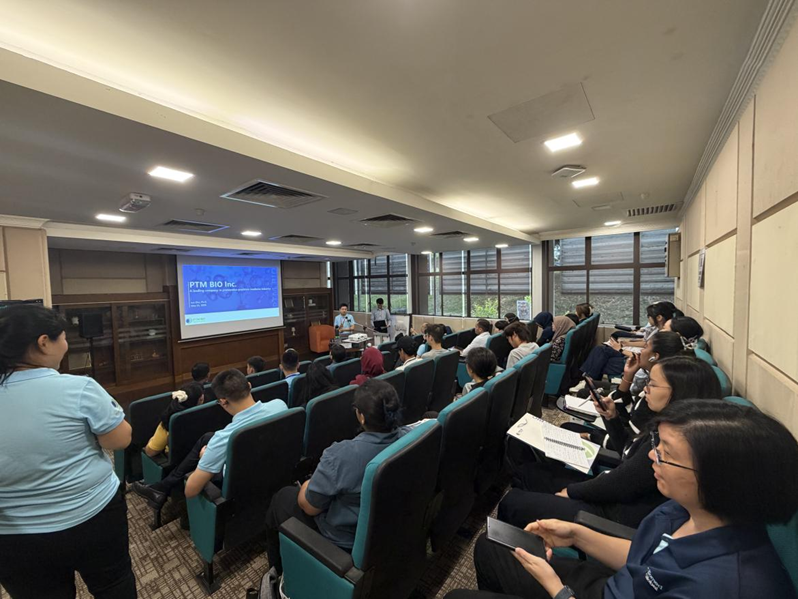
During the conference, the on-site discussions were particularly lively. The audience engaged in in-depth discussions with the speakers on topics such as detection methods for acylation modifications, customised requirements for bioinformatics analysis, and the application of the PTM Bio technology platform in specific research contexts.
The successful staging of this academic forum in Malaysia marks a significant milestone in PTM Bio’s efforts to promote proteomics within the Asia-Pacific market. As a leading company in proteomics and a pioneer in post-translational modification research, PTM Bio will continue to strengthen its collaboration with international academic institutions and industry partners, such as the University of Malaya and Biomed Global, to drive the innovative application of proteomics technologies in fields such as precision medicine.